
22 August 2026
Pakistan Climate Change: What the Latest News Means for Communities
Understanding Pakistan's Climate Reality in 2026
Pakistan consistently ranks among the world's most climate-vulnerable countries. The Global Climate Risk Index has placed Pakistan in the top ten most affected nations for much of the past two decades, and the pattern has not changed. What has changed is the frequency and intensity of climate events, and what they mean for ordinary communities across the country.
This article does not offer reassurance. It offers a clear-eyed look at where Pakistan stands on climate change, what the most significant recent developments mean in practical terms, and what communities, professionals, and policymakers can do in response.
The Ground-Level Reality: What Climate Change Looks Like in Pakistan
Pakistan's climate vulnerability is not abstract. It plays out in specific, measurable ways across different regions.
Glacial Melt and the Water Security Crisis
Pakistan holds the largest concentration of glaciers outside the polar regions, with over 7,000 glaciers in the Karakoram, Hindukush, and Himalayan ranges. These glaciers feed the Indus River system, which supports agriculture for hundreds of millions of people. As temperatures rise, glacial melt is accelerating, contributing to both short-term flooding and long-term water scarcity.
Glacial Lake Outburst Floods, known as GLOFs, are increasing in frequency. Communities in Gilgit-Baltistan and Khyber Pakhtunkhwa are particularly exposed. The UNDP GLOF-II project in Pakistan has worked to install early warning systems in vulnerable valleys, but coverage remains incomplete relative to the scale of the risk.
Monsoon Disruption and Extreme Rainfall
Pakistan's monsoon system is becoming more erratic. Rainfall that once arrived in predictable seasonal patterns now arrives in concentrated bursts, overwhelming drainage infrastructure in cities like Karachi, Lahore, and Peshawar. Rural areas face a different but equally serious problem: delayed or below-average monsoons in some years reduce crop yields, while excess rainfall in others destroys standing crops and damages soil structure.
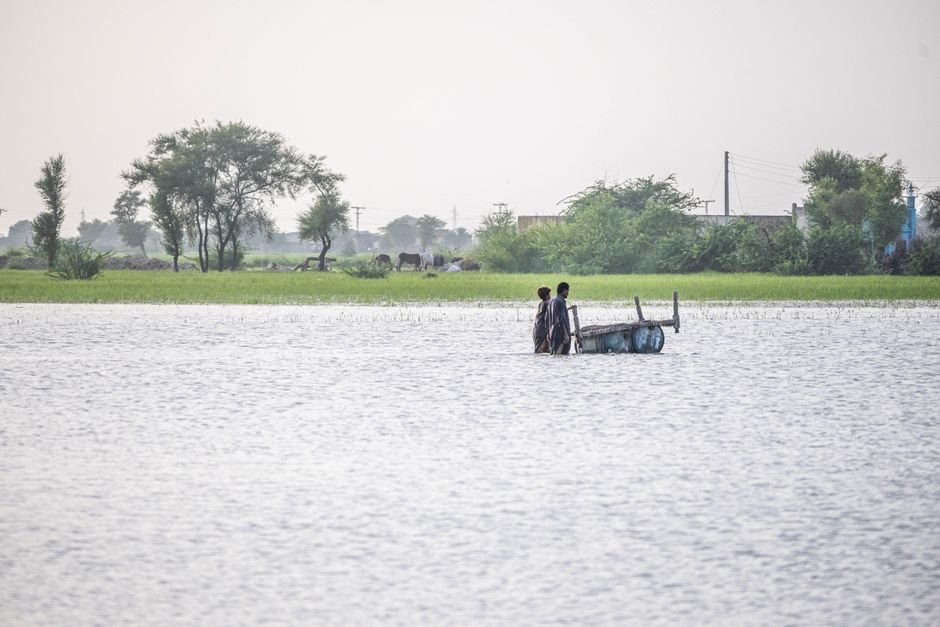
The 2022 floods, which affected roughly one-third of the country's land area and displaced over 30 million people, remain the most visible recent example of what concentrated monsoon rainfall combined with poor drainage and land-use planning can produce. The recovery process in many affected areas in Sindh and Balochistan extended well into subsequent years, with agricultural land remaining waterlogged long after the floodwaters receded.
Heatwaves and Urban Heat Islands
Pakistan's cities are getting hotter. Karachi, Lahore, Multan, Jacobabad, and Sibi regularly record temperatures above 45 degrees Celsius during summer months. Jacobabad has been cited in international climate research as one of the locations on earth that has already crossed the wet-bulb temperature threshold at which outdoor work becomes physiologically dangerous for extended periods.
Urban heat island effects worsen the situation in major cities, where dense construction, limited green cover, and heat-absorbing road surfaces push local temperatures several degrees above surrounding rural areas. Communities with limited access to electricity, particularly in low-income urban settlements, face serious health risks during extreme heat events.
What Recent Policy Developments Mean for Communities
Pakistan's Updated NDC and What It Commits To
Pakistan submitted an updated Nationally Determined Contribution under the Paris Agreement, committing to reduce its projected greenhouse gas emissions by up to 50 percent by 2030, conditional on receiving international climate finance. The unconditional target is a 15 percent reduction.
It is important to be clear about what this means in practice. Pakistan contributes less than one percent of global greenhouse gas emissions. Its NDC commitments are therefore primarily about positioning for climate finance and demonstrating good faith in international negotiations, rather than being the primary driver of global temperature outcomes. The more immediate question for communities is whether the adaptation components of the NDC translate into funded, implemented programmes.
Adaptation measures outlined in Pakistan's climate planning include improved flood early warning systems, drought-resistant crop varieties, coastal protection in Sindh and Balochistan, and urban heat action plans. Progress on these measures has been uneven, and communities in the most vulnerable areas often report that national-level commitments have not translated into visible local action.
The National Climate Change Policy and Its Provincial Implementation
Pakistan's National Climate Change Policy, administered under the Ministry of Climate Change and Environmental Coordination, provides a framework for climate action across sectors. However, under the 18th Constitutional Amendment, most implementation authority rests with provincial governments. This creates a structural challenge: national commitments require provincial capacity and political will to execute.
Sindh and Khyber Pakhtunkhwa have made relatively more visible progress on provincial climate legislation and adaptation planning. Punjab, which holds the largest share of Pakistan's population and agricultural land, has significant ongoing work in areas such as smog control and water conservation, though integrated climate adaptation planning remains a work in progress. Balochistan, which faces acute climate stress through drought and coastal erosion, continues to face serious capacity constraints.
Climate Finance: The Gap Between Pledges and Disbursement
Pakistan has been an active voice in international climate finance negotiations, and the country has received commitments from multilateral development banks and bilateral donors for climate-related programmes. The Asian Development Bank, World Bank, and Green Climate Fund have all funded projects in Pakistan related to flood resilience, renewable energy, and agricultural adaptation.
However, a gap consistently exists between pledged finance and actual disbursement to affected communities. Complex project approval processes, fiduciary requirements, and limited local implementation capacity mean that funding announced at the international level often takes years to reach the communities it is intended to support. This is not unique to Pakistan, but it is a persistent source of frustration for local governments and community organisations working on the front lines of climate adaptation.
What This Means for Specific Communities
Farming Communities and Food Security
Agriculture employs a significant share of Pakistan's workforce and contributes substantially to GDP. Climate change is already affecting crop calendars, water availability for irrigation, and the viability of traditional farming practices in many areas. Wheat, cotton, and rice, three of Pakistan's most important crops, are all sensitive to temperature and water stress.
Farmers in southern Punjab and upper Sindh are reporting changes in sowing seasons, increased pest pressure linked to warmer winters, and reduced canal water availability during critical growth periods. Without access to updated agronomic advice, drought-tolerant seed varieties, and functioning water management infrastructure, smallholder farmers are particularly exposed.
Coastal Communities in Sindh and Balochistan
Pakistan's coastline stretches over 1,000 kilometres. Coastal communities in the Indus Delta region of Sindh are facing a combination of sea-level rise, reduced freshwater flow from the Indus due to upstream diversions, and increased cyclone intensity in the Arabian Sea. Mangrove degradation, which reduces the natural buffer against storm surge, has been a long-standing problem in the delta, though restoration efforts are underway in several areas.
Makran Coast communities in Balochistan face their own set of pressures, including increased cyclone frequency and fishing disruptions linked to changing sea surface temperatures.
Urban Communities and Infrastructure Stress
Pakistan's cities were largely not designed with climate resilience in mind. Drainage systems in major urban centres are frequently overwhelmed by intense rainfall events. Green spaces, which provide cooling and water absorption, are under pressure from urban expansion. Low-income communities, which often occupy flood-prone land with limited infrastructure, are disproportionately affected.
City-level climate action plans exist for some major urban centres, but implementation depends on municipal capacity and funding that is often insufficient relative to the scale of need.
What Environmental Professionals Can Do
For environmental professionals working in Pakistan, the current situation calls for practical engagement across several areas. These include contributing technical expertise to Environmental Impact Assessments that properly account for climate risk, supporting local governments in developing climate adaptation plans, engaging with communities to translate technical information into actionable guidance, and participating in research and monitoring that builds the evidence base for better policy.
There is also a role for professionals in holding institutions accountable: tracking whether commitments in national and provincial climate plans are being implemented, and communicating gaps clearly and constructively to policymakers and the public.
This article reflects general analysis of publicly available information and does not represent an official policy position of PAEP.
Frequently Asked Questions
Q1. How does climate change specifically affect Pakistan more than other countries?
Pakistan faces a combination of factors that make it particularly vulnerable: high dependence on glacier-fed rivers for water and agriculture, a large rural population exposed to weather extremes, rapidly growing cities with inadequate infrastructure, and limited fiscal space for adaptation investment. These factors interact to amplify the impact of climate events that might be manageable in countries with greater resources and more resilient infrastructure.
Q2. What is a Glacial Lake Outburst Flood and why does it matter for Pakistan?
A Glacial Lake Outburst Flood occurs when a lake formed by glacial melt suddenly releases large volumes of water, typically because the ice or moraine dam holding the lake gives way. Pakistan's northern mountain regions contain hundreds of such glacial lakes, and their number is growing as temperatures rise. When a GLOF occurs, it can send walls of water and debris down narrow valleys within minutes, destroying bridges, roads, homes, and farmland with little warning.
Q3. What is Pakistan's NDC and does it make a difference to global climate outcomes?
Pakistan's Nationally Determined Contribution is its formal commitment under the Paris Agreement outlining what it will do to reduce emissions and adapt to climate change. Because Pakistan contributes less than one percent of global greenhouse gas emissions, its NDC has a minimal direct effect on global temperature trajectories. Its significance lies more in Pakistan's ability to access international climate finance, demonstrate policy credibility, and engage constructively in global negotiations where collective commitments matter.
Q4. Why does climate finance often fail to reach affected communities in Pakistan?
Climate finance from international sources typically flows through multilateral institutions and national governments before reaching local levels. Each stage involves approval processes, reporting requirements, and procurement rules that can significantly delay implementation. At the local level, limited technical capacity in municipal and district governments makes it harder to absorb and deploy funds effectively. Strengthening local implementation capacity is one of the most important and underappreciated aspects of making climate finance work in practice.
Q5. How can environmental professionals in Pakistan contribute to climate adaptation efforts?
Environmental professionals can contribute in multiple ways: conducting rigorous Environmental Impact Assessments that integrate climate risk, advising local governments on adaptation planning, supporting community-level awareness and capacity building, conducting applied research on Pakistan-specific climate impacts, and engaging with regulatory processes to strengthen environmental governance. Professional organisations like PAEP provide a platform for networking, knowledge-sharing, and coordinated engagement with policymakers on these issues.